Long-Term Memory for Conversational Agents: Extraction, Guardrails, and Hierarchical Retrieval
How does an assistant remember you across sessions? A speaker-attributed extraction pipeline with dedup and rate limits, three isolation scopes, and a retrieval hierarchy that ranks topics, decays by recency, and never truncates silently.
 Teo ParashkevovPublished6 min read
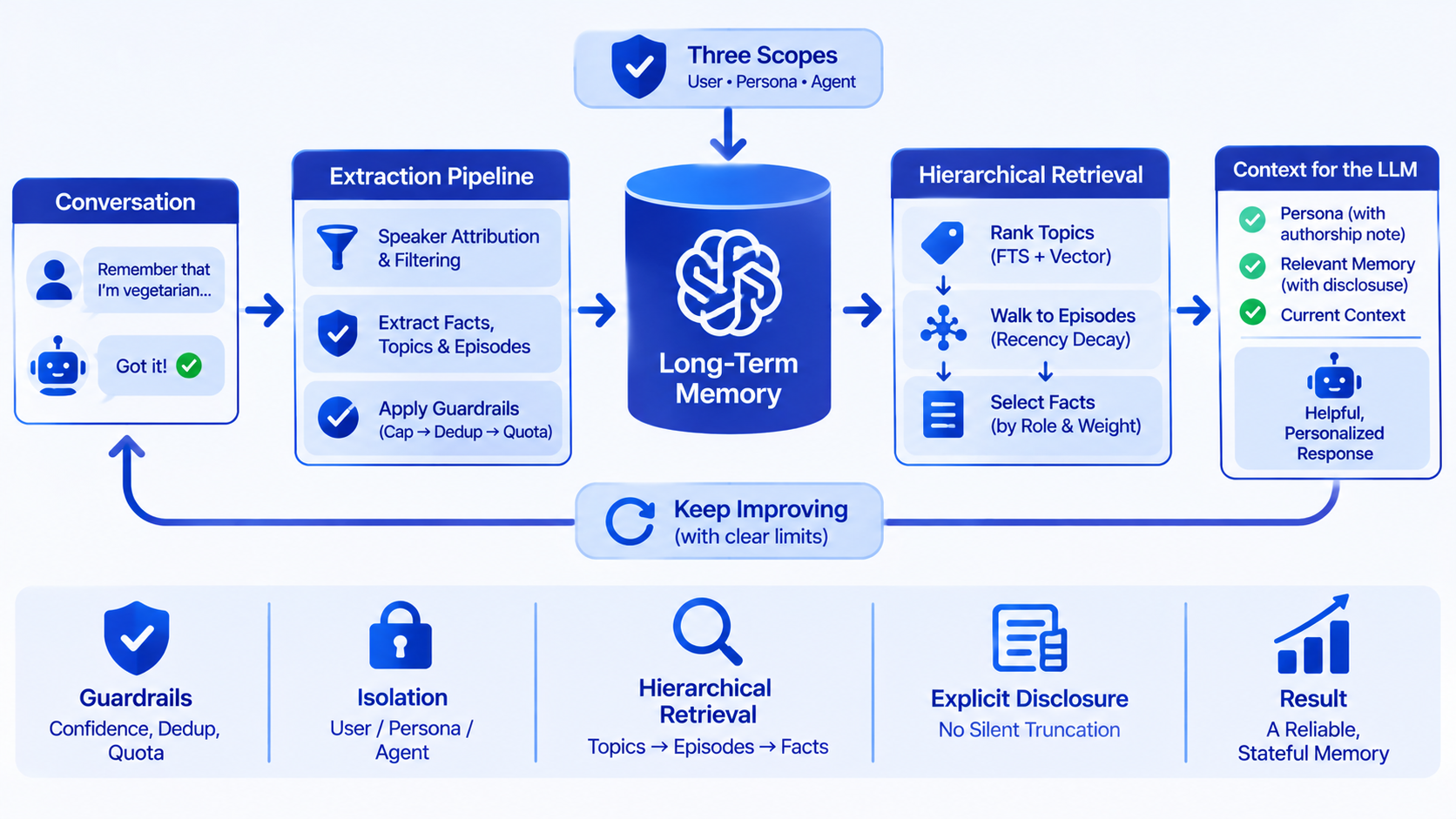
“Remember that I’m a vegetarian and my daughter is named Maya.” A conversational agent that retains facts across sessions feels qualitatively different from one that starts blank every time — but building that memory is a minefield of wrong attributions, duplicate facts, stale context, and privacy bleed. This post covers the three subsystems that make it work: an extraction pipeline that turns conversations into structured memory, guardrails that keep the pipeline honest, and a retrieval system that assembles the right context at session start.
The extraction pipeline: conversations to facts
Trigger: when a session ends (or a websocket disconnects), a background task distills the transcript into memory. The pipeline is speaker-attributed — and that attribute is the first correctness line:
Speaker partitioning. Messages are grouped by sender id. Two filters apply immediately: any sender id that isn’t a parseable user UUID is dropped (bots, system senders, malformed values — excluded by construction, not by name-matching), and each human speaker is processed in isolation with its own database session, so one speaker’s extraction failure never rolls back another’s. The meeting organizer must not silently receive everyone’s extracted facts; each participant accrues only their own.
Quality gate. Not every utterance deserves memory. A classifier splits kept/dropped by meta-conversation patterns (“can you hear me?”, “thanks, bye”) — phatic and housekeeping speech yields no facts.
Sub-extraction (each an LLM call in JSON mode, low temperature):
- Episode: title, summary, short transcript excerpt per speaker-bucket.
- Facts: subject–predicate–object triples, each with a role (
core,context,detail,temporal,causal— a closed, configurable vocabulary; unknown roles dropped) and a confidence/weight. Capped per episode (e.g. 50) — an unbounded extractor turns one meeting into ten thousand trivia facts. - Topics: an LLM matcher decides merge into an existing user-owned topic or create new. Merge-into-someone-else’s-topic is rejected; the topic vocabulary is user-owned.
Idempotency. The pipeline is keyed on (session_id, speaker_user_id): a second run for an already-processed speaker is a no-op. Reconnects and retries therefore don’t duplicate memory.
Structured evidence. If the session had explicit goals (an interview with goal tracking), terminal goals convert into core-role facts attributed to the session owner only. And if the session’s counterpart was a virtual persona rather than a human, every extracted row is stamped with that persona id — which sets up the isolation story below.
Guardrails: cap, dedup, quota — in that order
Uncontrolled extraction turns memory into noise. Three guards, applied in a deliberate order per candidate fact:
- Confidence cap — facts below a confidence floor never reach the dedup stage.
- Semantic dedup — embed the candidate and compare against recent facts by cosine distance; a near-duplicate doesn’t insert a new row, it reinforces the existing one (incrementing a
reinforced_count). Memory should deepen with repetition, not widen. - Daily quota — a per-user cap on new inserts bounds cost and abuse. Over-quota candidates are skipped, not errors.
The order matters: dedup before quota means an already-known fact (a reinforcement) never burns quota; quota-skipped candidates leave no partial state.
Isolation: three scopes
Memory rows carry three nullable scope keys — user_id, vperson_id, agent_id — and every read filters on all three:
vperson_idNone vs. set splits the human graph from virtual-persona graphs. A persona’s memory and its human operator’s memory are fully isolated in both directions; partners’ facts never bleed into a persona’s graph and vice versa.agent_id(nullable) scopes to the assistant instance that wrote the memory — preventing cross-agent bleed when one user talks to several different agents.
These keys are threaded through every level of retrieval (topic → episode → fact), enforced in the SQL where clauses and — because some post-filtering happens in code after graph walks — re-checked as post-filters too. Scoping is only real when it’s defense-in-depth.
Vector storage: raw SQL on purpose
Embeddings live in Postgres with pgvector. The insert path uses raw SQL (CAST(:embedding AS vector)) rather than the ORM — a deliberate workaround: the SQLAlchemy type binder and the asyncpg pgvector binary codec both claim the bind parameter and disagree on wire format. The raw-SQL bypass, rendering the vector as a literal string, is the documented, tested escape hatch. Similarity uses cosine distance (<=>), with the vector index created by migration.
Retrieval: hierarchy plus fusion
Session start needs context assembly in one call. The retrieval is hierarchical, with the same hybrid machinery as document search (full-text, vector, or both fused by Reciprocal Rank Fusion with k=60):
- Rank topics matching the current context (full-text via
tsvector, vector via embedding the query, or RRF over both). - Walk edges from scored topics to their episodes:
edge_score = edge_weight × recency_decay(last_episode_at), whererecency_decay(age) = 0.5 ** (age_days / half_life)— exponential half-life decay (default 30 days, configurable). Old topics fade smoothly; nothing is hard-cut. - Pull candidate facts from scored episodes, filter by the three scope keys, sort by
(role_priority, -weight, -episode_score)— core facts first, heavy facts first, well-attested episodes first. - Cap with disclosure. The assembled context has a character budget (e.g. 4000). If facts must be dropped, the response states exactly what was withheld: “Showing 8 of 12 facts; withheld oldest 4.” Silent truncation of identity-shaping context is a failure mode that produces subtle, unreproducible assistant misbehavior; disclosure converts it into an observable decision.
Persona-first injection with an authorship disclaimer
The reserved topic holding the persona description is always rendered first — and carries a header explicitly disclaiming authorship, stating that the following was written about the persona (possibly by other people), not by it. Without that sentence, a model reads partner-authored persona text as its own voice and history — a small line of text that prevents a large class of confabulation. If persona facts are withheld by the budget, the disclaimer says that too.
Session-recall framing matters equally: facts from previous sessions are introduced with a header marking them as a different, finished conversation — otherwise the model confuses past-session answers with the current session’s state and responds to things that were never said in this room.
Takeaways
- Speaker-attributed extraction with bot exclusion, per-speaker transactions, and
(session, speaker)idempotency — attribution errors are the worst memory bugs. - Guardrails in order: confidence cap → semantic dedup (reinforce, don’t duplicate) → daily quota.
- Three-scope isolation (
user/vperson/agent) enforced in SQL and post-filter. - Hierarchical retrieval: rank topics, walk weighted edges with half-life recency decay, sort facts by role and weight, cap with explicit disclosure.
- Persona context gets an authorship disclaimer; past sessions get a “different conversation” header — framing text is cheap, confabulation is expensive.
Memory is not a database feature; it’s a set of disciplined pipelines — what to extract, whose it is, what to drop, what to surface, and how to frame it. Get the disciplines right and the agent changes from a stateless parrot into something that demonstrably knows you — without ever confusing whose memory is whose.