Leader Election and Job Claiming with Postgres Advisory Locks
How to run a distributed scheduler on a single table: advisory-lock leader election, SKIP LOCKED work claiming, semaphore-style concurrency caps, and heartbeat reaping.
 Teo ParashkevovPublished6 min read
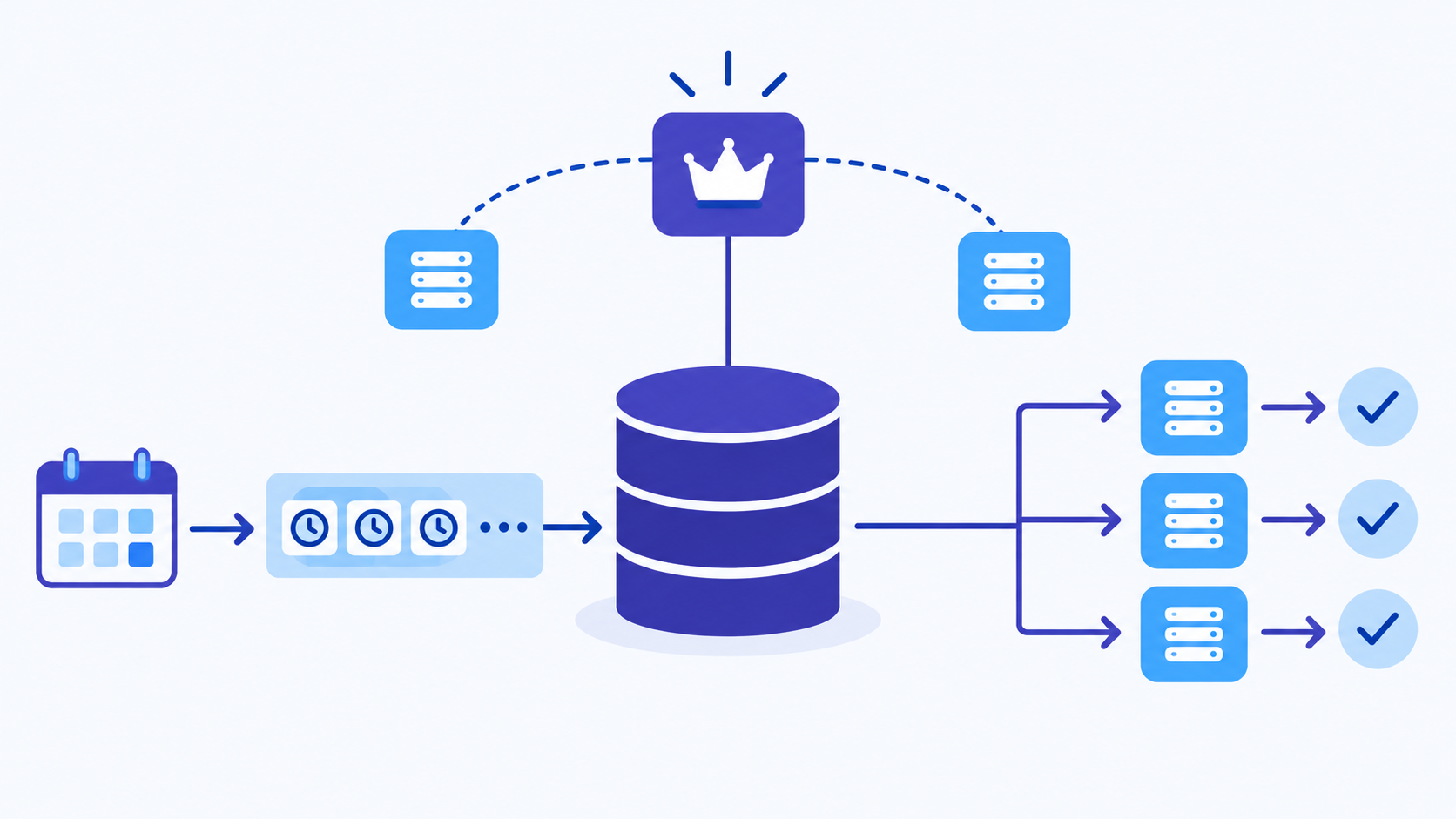
A background scheduler — cron jobs, one-shot tasks, recurring reports — has a deceptively simple requirement: exactly one worker should execute each job, even when there are many workers, and even when workers die mid-job. Redis and a dedicated queue broker are the usual answers, but a surprising amount of this can be built directly on Postgres with three primitives: advisory locks, SELECT ... FOR UPDATE SKIP LOCKED, and heartbeats. This post is a tour of that design.
The tick loop and leader election
The scheduler is a loop that wakes every N seconds and runs four phases: materialize due cron definitions, materialize due one-shot definitions, reap orphaned runs, and dispatch queued work. Running this loop on every replica would multiply every job; running it on a statically assigned replica forfeits failover. So: elect a leader per tick, cheaply, with pg_try_advisory_lock.
SELECT pg_try_advisory_lock($1); -- session-scoped, returns true/false immediatelyKey properties:
- Try, don’t block.
pg_try_advisory_locknever waits. If another replica holds the lock, this replica’s tick is a no-op and it goes back to sleep. There is no lock queue, no convoy, no latency added to request-serving replicas. - Session scope, explicit release. The lock survives across transactions (unlike row locks), which is exactly what a tick needs — each phase commits its own transaction, and the lock must still be held across phases. The holder calls
pg_advisory_unlockexplicitly on exit. - Fails open. If the database blips, the tick logs and sleeps; the loop does not crash. A scheduler that dies silently is worse than one that runs late, so the worst case is always “this tick didn’t happen”.
Two failure modes worth naming: if the leader process is paused (GC, container freeze) for longer than the lock’s implicit lifetime assumptions, another replica can acquire the lock and you get two leaders briefly — which is why every claim below is still atomic. Leader election narrows who dispatches; it does not replace atomic claiming.
Materialization: turning schedules into runs
Schedules and runs are different tables on purpose. A JobDefinition holds the durable intent (“every weekday at 09:00 Europe/Sofia”); a JobRun holds one execution (“queued at 09:00:03, attempt 2”). Materialization converts the first into the second, once, using an idempotency marker: the definition’s next_run_at is advanced in the same transaction as the run row insert. A crash between the two is impossible because they’re one commit. The recurrence rule is parsed with DTSTART anchored in the definition’s timezone — not UTC — because BYHOUR=8 must mean 08:00 local, and that one detail is the difference between a report that arrives at standup time and one that arrives at lunch.
Claiming work: SKIP LOCKED
Dispatch is the moment of truth — many claimers (the tick leader, ad-hoc “run now” requests, maybe a retry dispatcher) can be racing over the same QUEUED rows. The claiming query:
UPDATE job_runs
SET status = 'RUNNING', started_at = now()
WHERE id IN (
    SELECT id
    FROM job_runs
    WHERE status = 'QUEUED' AND scheduled_for <= now()
    ORDER BY scheduled_for
    LIMIT $1
    FOR UPDATE SKIP LOCKED
)
RETURNING *;
FOR UPDATE SKIP LOCKED is the load-bearing phrase: rows already locked by a concurrent claimer are skipped, not waited on. Each claimer gets a disjoint slice with zero contention and zero double-claims. Two replicas can dispatch at the same instant and still never see each other’s rows.
One deliberate overshoot: the candidate pool selects roughly 4 × batch_size before the cap filter runs. Without the overshoot, one over-represented definition (hundreds of queued runs of the same job) sitting at the front of the order could crowd out everything else before per-job limits apply.
Concurrency caps without a counter
Each definition has max_concurrent_runs — and it must hold across replicas, so an in-process counter is disqualified. Instead, the dispatcher counts live RUNNING rows in the same database the workers are updating:
SELECT definition_id, count(*)
FROM job_runs
WHERE status = 'RUNNING' AND definition_id = ANY($1)
GROUP BY definition_id;
The subtle part is when you read that count relative to the locks you hold. Concurrent dispatchers claiming different runs of the same definition must serialize against each other, or both read “2 running” with a cap of 3 and both claim, ending at 4. The serialization tool is again an advisory lock — transaction-scoped this time, keyed by definition id:
SELECT pg_advisory_xact_lock(hashtextextended('dispatch:' || definition_id, 0));Two rules make this safe:
- Acquire in sorted order (by definition id). Two dispatchers acquiring the same set of locks in different orders is textbook deadlock; a global sort order eliminates it.
- Read running counts after acquiring. The advisory lock guarantees no concurrent dispatcher is mid-claim for this definition, so the count you read includes every commit that matters.
Definitions at their cap are skipped, not failed — their rows stay QUEUED for a later tick. Backpressure, not error.
Heartbeats and the orphan watchdog
A RUNNING row is a promise; the promise needs a liveness signal. Every worker stamps heartbeat_at on a fixed cadence from a background task — importantly, a failing heartbeat write must never kill the work it watches. The heartbeat loop logs and continues.
The reaper looks for two orphan signatures, both as set-based UPDATEs (one query each, not per-row loops):
- Stale heartbeat:
heartbeat_at < now() - heartbeat_timeout→FAILED, reasonHeartbeatLost. - Never heartbeated:
heartbeat_at IS NULL AND started_at < now() - orphan_timeout→FAILED, reasonOrphaned— the worker that claimed it died before its first heartbeat.
The never-heartbeated window should be generous. Slow-but-alive jobs (a big build, a long report) look identical to dead ones from the outside; the only defense is a timeout comfortably beyond the slowest legitimate heartbeat gap.
Cancellation as a checkpoint
Cancellation is cooperative: the run row carries cancel_requested, and the worker calls a checkpoint() between steps. This is the only design that survives partial side effects — an uncooperative kill leaves “was the email sent?” unanswerable. A checkpoint that observes the flag raises, and mutating job kinds get a chance at best-effort compensation (marking partial writes) before the exception propagates to the runner, which stamps cancelled. Read-only kinds just propagate.
Retries: new rows, not overwritten attempts
When a run fails and the retry policy allows another attempt, the system inserts a new JobRun with attempt = n+1 and scheduled_for = now + backoff, and marks the old row FAILED — it does not rewrite the failed row in place. Three wins:
- Audit trail: every attempt, with its own logs and error, is preserved.
- Backoff for free: the dispatcher only claims rows whose
scheduled_for <= now, so a futurescheduled_foris the backoff delay. No timers, no delay queues. - The claim/dispatch machinery is reused: a retry is just another queued row.
The retry policy itself is a small pair of allow/deny lists per job kind — a deny list checked first (some exceptions, like budget exhaustion, must never retry even though a broad allow-list would match), and the deny always wins when both match.
The shape of the whole system
definitions ──materialize──▶ runs (QUEUED, scheduled_for)
runs ──SKIP LOCKED claim──▶ RUNNING ──heartbeat──▶ alive?
                                  │heartbeat lost ──▶ FAILED (orphaned)
                                  │success          ──▶ COMPLETED
                                  │failure+retry    ──▶ FAILED + new QUEUED row (backoff)
Takeaways
pg_try_advisory_lockgives you per-tick leader election with no extra infrastructure; session scope + explicit release matches a multi-transaction tick.FOR UPDATE SKIP LOCKEDturns “who claims this row?” from a locking problem into a no-waiting slice. Oversample candidates so per-job caps can’t starve the batch.- Enforce concurrency caps against live DB counts, serialized by per-definition advisory locks taken in sorted order — never in-process counters.
- Heartbeats + set-based reaping detect death; cooperative checkpoints make cancellation safe; retries-as-new-rows give you audit, backoff, and machinery reuse for free.
The theme: the database you already have contains a work queue, a leader-election primitive, and a semaphore. The trick is knowing which lock flavor and which SELECT modifier to reach for.