Token Bucket Rate Limiting and Constant-Time Credential Verification
The small but sharp security machinery behind an API endpoint: in-memory token buckets, peppered SHA-256 with constant-time comparison, and deterministic session namespacing.
 Teo ParashkevovPublished4 min read
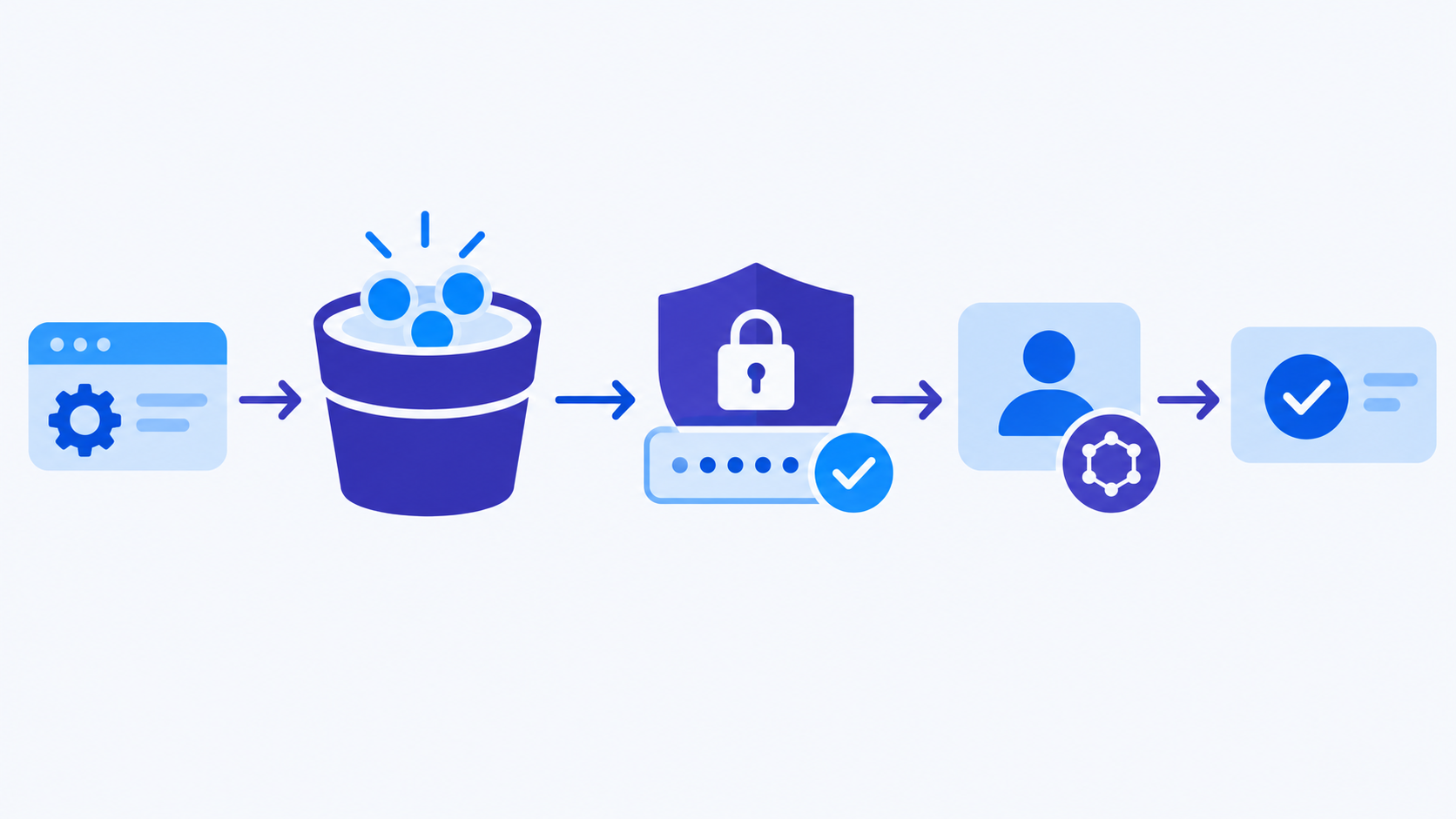
Every API endpoint that issues programmatic credentials eventually needs the same three pieces of security machinery: a rate limiter that fails gracefully, credential storage that survives a database dump, and session isolation that can’t be crossed by accident. None of them require a security appliance — each is about forty lines of careful code. This post walks through implementations and the reasoning behind each choice.
Rate limiting: the token bucket
The algorithm: each caller (identified by credential id) has a bucket holding up to capacity tokens, refilling at refill_per_second. A request costs one token; a request with no tokens available is rejected with 429.
@dataclass
class Bucket:
    tokens: float
    last_refill: float

class TokenBucketLimiter:
    def __init__(self, capacity: float = 60.0, refill: float = 1.0):
        self.capacity = capacity
        self.refill = refill
        self._buckets: dict[str, Bucket] = {}

    def allow(self, key: str) -> bool:
        now = time.monotonic()
        bucket = self._buckets.get(key)
        if bucket is None:
            bucket = Bucket(tokens=self.capacity, last_refill=now)
            self._buckets[key] = bucket
        # Refill based on elapsed time, capped at capacity
        bucket.tokens = min(
            self.capacity,
            bucket.tokens + (now - bucket.last_refill) * self.refill,
        )
        bucket.last_refill = now
        if bucket.tokens < 1.0:
            return False
        bucket.tokens -= 1.0
        return True
Three properties make this the right default:
- Burst tolerance. Unlike a fixed window (“100 requests per minute, resetting at :00”), a full bucket lets a client burst 60 requests instantly — then drains to a sustainable 1/second. Interactive clients get snappy behavior; abusive scripts hit the refill ceiling immediately.
- Lazy state. No background timer mutates buckets; refill is computed on access from elapsed time. Idle callers cost zero memory updates and buckets for users who left expire naturally.
- No clock dependency.
time.monotonic()never jumps (unlike wall time, which NTP can smear backwards). Rate limiting on a jumping clock produces both accidental 429 storms and limiter bypass; monotonic time cannot.
Its documented limitation is equally important: this is per-process. With multiple replicas, each holds its own buckets and the effective limit multiplies. For many APIs that’s acceptable (the limit exists to protect, not to bill against); the moment it isn’t, the replacement is a shared store — and the interface (allow(key) -> bool) doesn’t change. Design the seam so the honest in-memory version isn’t a lie, and the upgrade is a swap, not a rewrite.
Also note where the limiter sits in the pipeline: after authentication (the key is the credential id) and before any work is dispatched. Unauthenticated traffic gets a cheaper 401 path; expensive requests never run for over-limit callers.
Storing API keys: pepper, hash, constant-time compare
Static API keys must be verifiable but not recoverable. The scheme:
Storage: sha256(pepper + plaintext), hex-encoded. The pepper is a site-wide secret held in configuration, never in the database. Two layers of defense follow:
- A database dump alone reveals nothing. Hashes are one-way, and without the pepper even rainbow tables and precomputed dictionaries are useless — the attacker needs both the dump and the deployment’s secrets.
- Empty pepper is a startup error in production. A missing pepper should hard-fail deployment in production while only warning locally; the failure mode “works on my machine, wide open in prod” must be structurally impossible.
Verification — the detail everyone gets wrong the first time:
hmac.compare_digest(hash_key(presented), stored_hash)Not ==. String comparison short-circuits at the first differing character, which turns verification into a timing oracle: an attacker measuring response times can reconstruct a valid key byte by byte. hmac.compare_digest runs in time independent of where the inputs differ. For an operation executed on every request, this is non-negotiable.
When the credential is a JWT instead of a static key, the hot path is pure cryptography — validate the signature, audience, expiry, and token type in-memory with the shared secret, no database. The database lookup and its latency only exist for static keys. A useful pattern: the principal (identity, scopes, bound user) is built once at authentication time and carried on the request scope, so every downstream layer reads a typed object instead of re-deriving or — worse — re-trusting request parameters.
Session namespacing: determinism as isolation
Programmatic agents that hold conversational state need sessions. The requirement: two different credentials, or two different users, must never land in the same session — even by accident, even with colliding context_id values supplied by callers.
The solution is a deterministic UUID:
SESSION_NAMESPACE = UUID("6f3a1d2e-...")  # fixed, version 5 namespace

session_id = uuid5(SESSION_NAMESPACE, f"{bound_user_id}:{credential_id}:{context_id or 'new'}")
uuid5 is SHA-1 based and deterministic: the same namespace + name always yields the same UUID. That turns session identity into a pure function of (user, credential, caller context), which buys three things:
- Isolation by construction. A different user or credential contributes a different name component, so a different UUID — no lookup, no collision check, no “is this session mine?” query.
- Idempotency. A retried request with the same
context_idreconnects to the same session instead of forking a duplicate conversation. - No state to manage. There is no session-id allocation service, no registry table, no race on insert.
The pattern generalizes: whenever an identifier needs to be stable, unique per input tuple, and computable anywhere, a namespaced UUIDv5 replaces a central allocator.
The pipeline as a whole
request
  → extract credential (header or Bearer)
  → resolve principal (DB hash verify, or crypto JWT validation)
  → rate limit by credential id        ┐ fail → 429
  → attach principal to request scope  ┘ fail → 401
  → dispatch to handler (session id via uuid5)
Each stage fails closed with the cheapest possible response, and each expensive decision (DB lookup, permission resolution) happens exactly once per request, upstream.
Takeaways
- Token bucket over fixed window for per-caller limits: burst-friendly, lazy, monotonic-clock-safe. Budget for the per-process caveat explicitly.
sha256(pepper + key)for storage,hmac.compare_digestfor verification. The pepper belongs in deployment config, and its absence must be a production startup failure. Timing safety is a one-function fix — don’t skip it.- JWTs keep the hot path DB-free; principals are built once and passed downstream.
- Namespaced UUIDv5 turns session identity into a pure function of (user, credential, context) — isolation, idempotency, and zero coordination in one move.
Security machinery ages well when each piece has one job and an honest statement of its limits. The in-memory limiter that documents “per-process” is more secure than the distributed one that’s half-migrated and nobody knows which limit is real.