A Supervision State Machine for Long-Running Background Tasks
Background jobs that run for minutes, pause for human answers, and survive restarts need more than a status column. A design for pausable, resumable, auditable background work: explicit states, a question channel, generation gates, and append-only logs.
 Teo ParashkevovPublished6 min read
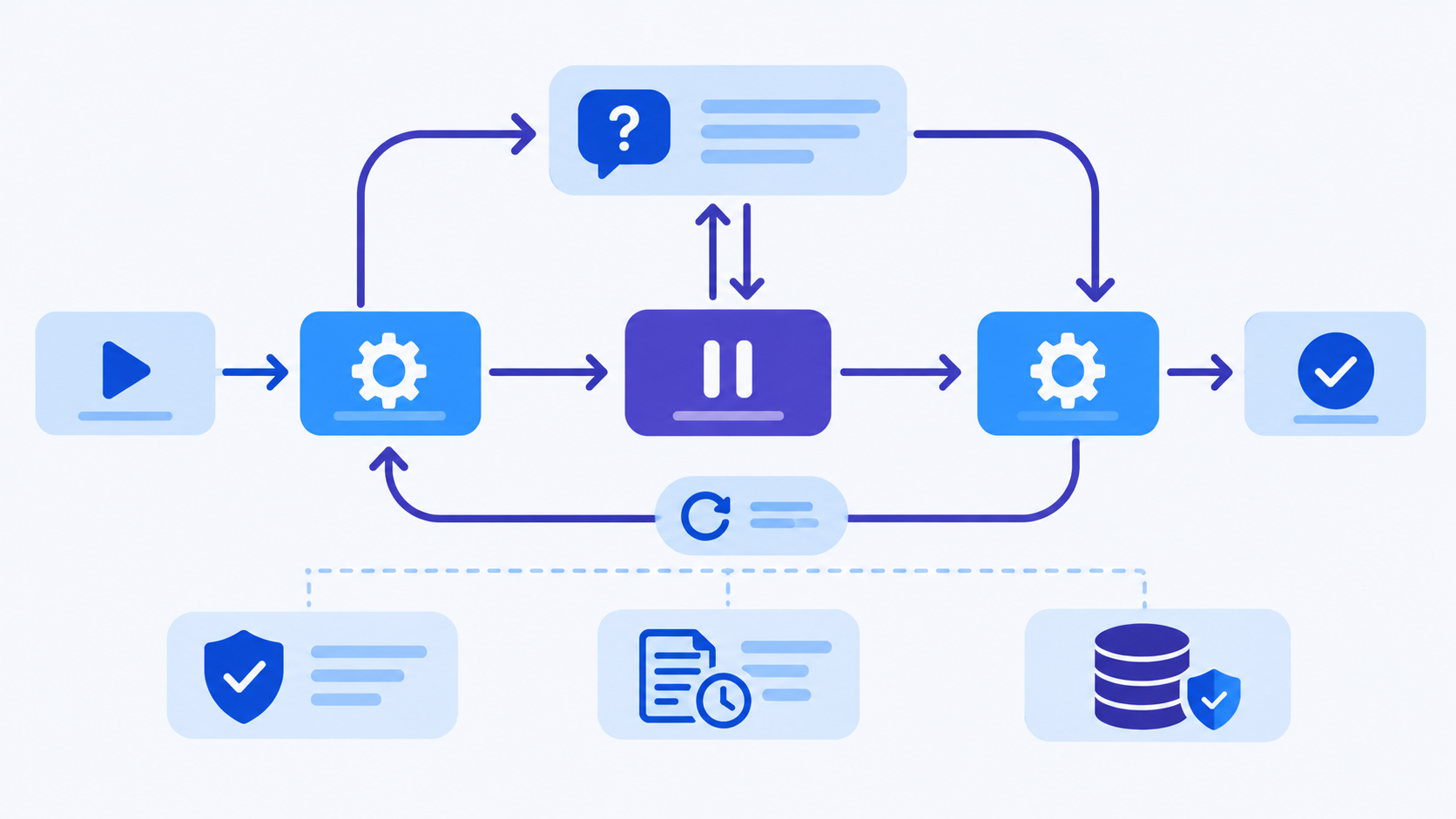
Most background-job systems are designed around the assumption that a job is a function call: enqueue, run, finish, maybe retry. The moment a job can run for tens of minutes, needs to ask a human a question mid-run, must survive a deploy mid-execution, and has to be auditable afterward — you’ve left that territory. This post is a design for that harder problem: a supervision layer with an explicit state machine, a question channel, and a few load-bearing invariants.
The state machine
States and their meanings:
pending → running → parked ⇄ running → completed | failed | expired- pending — created, not yet claimed.
- running — claimed by a worker, executing.
- parked — suspended at a known checkpoint, waiting on something (usually a human answer or a pause request). Not failed; exactly resumable.
- completed / failed / expired — terminal. Never re-entered.
Two rules hold the machine together:
- Every transition is atomic. Each state change happens inside
session.begin()withSELECT ... FOR UPDATEon the task row. A worker that crashes between “read state” and “write state” simply never completes the transaction — the row shows the old state, and the orphan watchdog (heartbeat-based, as in any scheduler) reaps it. There is no observed-but-not-committed window for a competing worker to exploit. - A parked task must always say why. A nullable
watchdog_stop_reasonaccompanies the state:awaiting_user_answer:{guard_name},user_paused,expired:{prior_reason}. Aparkedrow with a NULL reason is an alarm — the invariant is enforced by tests rather than a CHECK constraint, because reasons are open-ended strings. (In practice:CHECKconstraints are for closed sets; a convention plus a test is for extensible vocabularies.)
A third field, generation (default 1), increments on every externally visible mutation. More on it below.
The question channel: ask without answering
The hardest requirement: a running job needs a human decision now, but the human answers in ten minutes. The design splits “ask” from “answer” into two operations that share only a table, never a return value:
Asking is a single atomic sequence — FOR UPDATE the task, insert a pending question row, flip the task to parked with the stop reason, append a log entry, flush for ids, then raise a control-flow exception:
async def ask(task_id, question_key, question_data):
    async with session.begin():
        task = await lock_task(task_id)          # SELECT ... FOR UPDATE
        question = BackgroundTaskQuestion(
            task_id=task_id, question_key=question_key,
            question_data=question_data, status="pending",
            expires_at=now() + QUESTION_TTL,
        )
        session.add(question)
        task.current_state = "parked"
        task.watchdog_stop_reason = f"awaiting_user_answer:{question_key}"
        session.add(log_entry(task_id, "question_asked", ...))
        await session.flush()                    # ids materialized
    raise QuestionAsked(question.id)             # control flow, not an error value
The raise matters. The worker’s stack unwinds completely — no dangling coroutine holding resources, no “paused generator” to leak. QuestionAsked is control flow, caught at the runner boundary, which records “parked at this point” and returns the worker to the pool.
Parking state is durable. Before the ask, the checkpoint writes locked_decisions (current node, accumulated bindings, visited set, run id) into the task row. This is the cold-resume contract: any worker, on any process, can reconstruct execution from the row alone. No module-level cache, no in-memory continuation, no framework checkpointing — a second executor given only sessionmaker + task_id is provably equivalent to the first. If your resume path reads anything that lives in process memory, it will work in tests and die in production.
Answering is a separate, equally atomic, operation: FOR UPDATE the question, verify still pending, write the answer with actor and timestamp, flip to answered, append a log entry, commit. Then — and only after the answer is durable — trigger resume. If resume loses the race (another path already resumed the task), the ValueError is swallowed: the answer is durable regardless of who won the race, which is the correct priority.
The schema enforces the load-bearing invariant: a CHECK constraint requires that status='answered' implies non-null answer text and answer timestamp. A question marked answered with no answer is a corruption class that should be impossible by construction, not detectable by audit.
Pause is a request, not a state flip
A user clicking “pause” cannot teleport the worker out of its current step — it might be mid-write. So pause is a request: set pause_requested_at, leave current_state untouched. The worker observes the flag at its next checkpoint() (between steps), transitions to parked with reason user_paused, and logs. The API always reports “pausing after the current step”, never “paused” — honest about the asynchrony, and safe under any worker latency.
Resume is a claim, symmetric to work-claiming in a queue: FOR UPDATE, verify state is parked, flip to running, release the lock, then drive the body forward from the durable checkpoint. Losers of the claim get a 409. This prevents the double-drive: two concurrent resumes both walking the same task’s body.
The symmetry is worth noticing: claim semantics (compare-and-swap under lock, loser gets told) appear for dispatch, for resume, and for answering. Long-running-state coordination is mostly the same two lines of SQL repeated at every decision point.
Expiry: single-clock ruling
Tasks and questions expire. The ruling that prevents an entire bug class: compare against database time, in SQL — WHERE expires_at < now() evaluated by Postgres, not datetime.now() fetched into Python. Application servers disagree with each other and with the database by seconds; a Python-computed cutoff means “expired” is a different predicate on every replica. One clock (the data store’s) or none.
An expiry sweep flips rows to expired with a reason that preserves the prior stop reason (expired:awaiting_user_answer:{guard}), logs per task, and — the important posture — never auto-proceeds. Expiry is terminal; the body refuses to resume an expired task. A task that asks a human, gets no answer, and guesses is worse than no task at all.
The generation gate
Distributed systems with optimistic UIs have a stale-client problem: a dashboard loaded five minutes ago shows a parked task that has since been answered and resumed; the user clicks “pause” against a state that no longer exists. The fix is a compare-and-swap on generation:
UPDATE tasks
SET current_state = 'running', generation = generation + 1
WHERE id = $1 AND generation = $2           -- the client's expected generation
RETURNING *;
Zero rows returned → someone else mutated first → 409 Conflict. Every mutation endpoint takes expected_generation; the server only ever increments. Clients naturally re-fetch on 409. This is the same compare-and-swap discipline as the resume claim, generalized to all task mutations — and it costs one integer column.
Auditing: append-only logs with honest truncation
Two properties matter for the audit trail:
Append-only, enforced structurally. REVOKE doesn’t work (the table owner bypasses it); a BEFORE UPDATE OR DELETE trigger raising an exception does. Log entries carry a per-task sequence_num (unique, monotonically increasing) so the trail is totally ordered even under concurrent writers.
Bounded disclosure, never silent. A task with ten thousand log entries can’t dump them into an API response. The projection returns the newest page with real counts:
{
  "returned_count": 50,
  "total_count": 10423,
  "withheld_count": 10373,
  "truncated": true,
  "entries": [...]   # newest page, reversed to chronological for display
}
truncated: true plus an exact withheld_count (from a real COUNT(*), not an estimate) means the response never silently drops entries. “You are not seeing everything, here is exactly how much” is the only honest truncation.
Ownership: identical 404s
Every read/mutation loads the row, compares owner_id against the caller, and returns the same 404 for “does not exist” and “exists but not yours”. Same status, same body shape. A foreign id that returns 403 or 404-with-different-shape confirms existence to an enumerator; an identical response does not.
The design in one picture
                    ┌─────────── question asked (atomic: lock, insert, park, log) ──────────┐
                    │                                                                      ▼
  pending ──claim──▶ running ══checkpoint==▶ parked ──answer durable + claim──▶ running ──▶ completed
                    │  ▲           │                                              │
                    │  └───────────┴── pause_requested_at observed ──▶ parked      ▼
                    │                                                    (stop reason: user_paused)
                    └── crash ──▶ (heartbeat watchdog reaps)
  every mutation: expected_generation compare-and-swap, else 409
  every log: append-only trigger; reads: bounded, counted, truncation disclosed
Takeaways
- Explicit states with an atomic transition each, plus a mandatory stop reason on every park — a parked row without a reason is an alarm.
- Ask and answer are separate atomic operations sharing only a table; the ask raises control-flow and parks; the answer is durable before resume is attempted.
- Cold-resume from the row only. Any executor given
sessionmaker + task_idmust be able to continue; in-memory state is a test-only illusion. - Pause is a request observed at checkpoints; resume is a claim. Expiry compares in SQL on the database clock and never auto-proceeds.
- One integer
generationcolumn turns every mutation into a compare-and-swap and retires the stale-client bug class. - Logs are append-only by trigger, and every bounded projection discloses exactly what it withheld.
Build a queue when jobs are calls. Build supervision when jobs are conversations with reality — and make the state machine boring enough that the interesting part is the work itself.